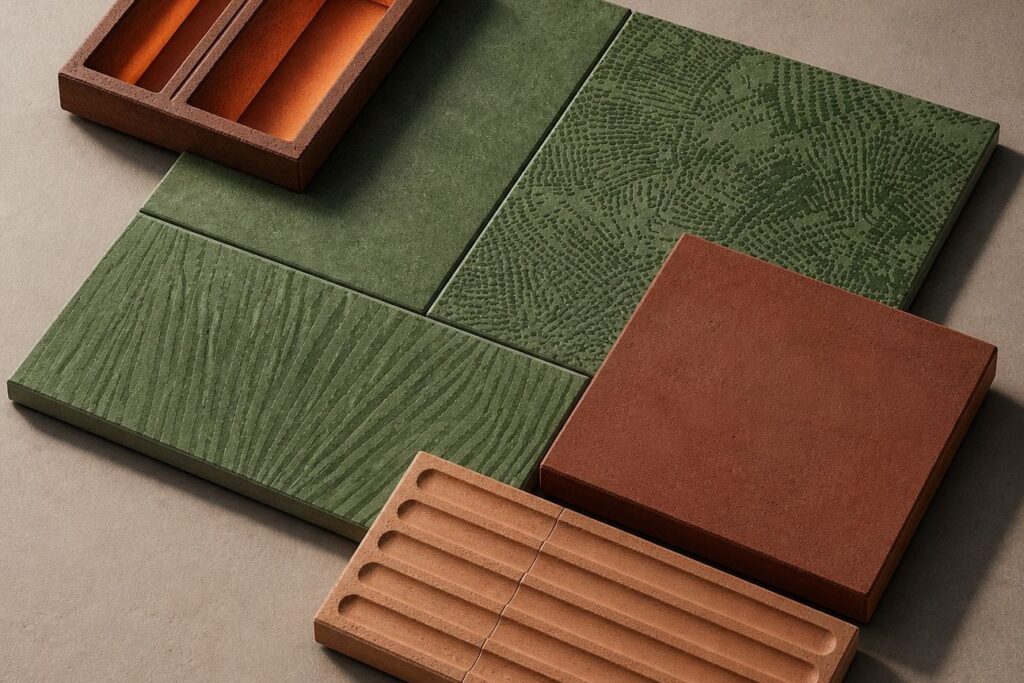
Handmade vs machine-made tiles: what’s the difference?
Handmade tiles are shaped, coloured or finished by hand, so every piece varies slightly and production is slower. Machine-made tiles are pressed and fired in controlled batches, so they are uniform, consistent in size and easier to install. Craft-inspired ceramic tiles sit in between: a handmade look with machine-made consistency.
Comparison
| Feature | Handmade (e.g. Athangudi) | Craft-inspired ceramic (e.g. Homemade) | Standard machine-made |
|---|---|---|---|
| Look | Unique, varied | Craft pattern and texture, consistent | Uniform |
| Size consistency | Small variation | Consistent | Consistent |
| Lead time | Longer, batch-made | Ask showroom | Usually in stock |
| Upkeep | Gentle cleaners | Wipe clean | Wipe clean |
| Best for | Heritage floors | Feature walls, hospitality, offices | Large areas, budget builds |
Where Homemade by Srinath Palette fits
Homemade by Srinath Palette takes six Indian crafts (Kantha, Pochampally ikat, Dabu, Phulkari, and eco prints from the parijatha flower and the banana leaf) into ceramic wall tiles. You get the craft story and texture without the variation and upkeep of fully handmade tiles.
Which should you choose?
- Want one-of-a-kind floors and don’t mind variation: handmade, such as Athangudi tiles.
- Want a craft feature wall that’s easy to specify and maintain: craft-inspired ceramic.
- Large areas on a budget: standard vitrified or ceramic.
For types, care and where to use them, read our handmade tiles buyer’s guide for Bangalore homes.
FAQ
Are handmade tiles more durable?
Not necessarily. Durability depends on the material and where it’s used; kiln-fired vitrified tiles are very hard-wearing.
Why do handmade tiles cost more?
Each piece takes more labour and time, and batches are smaller.
Can architects get samples?
Yes. Architects and designers anywhere in India can request samples from Srinath Collective, Rajajinagar, Bengaluru.